|
|
|
|
Mieh w Mieh
- Ameen al-Rihani
Ameen
al-Rihani
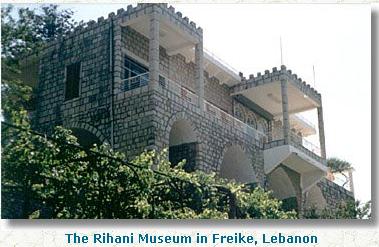
the founding father of Arab-American literature (born 1876 in Freike, Lebanon;
died 1940) was a Lebanese writer, a major figure in the mahjar literary
movement developed by Arab emigrants in North America, an early theorist of
Arab nationalism and an active supporter of the Arab Palestinian cause.
Al-Rihani became an American citizen in 1903.. |
|
|
|
|
|
|
|
|
|
|
The eldest of six children born to a Maronite silk manufacturer, Al-Rihani
emigrated from his native Lebanon to New York at the age of twelve. There he
continued his education, largely as an autodidact, while also working in his
father's trading business. He returned to Lebanon for the first time in
1898, and made various visits at later stages, but after World War I
returned to spend more time in the Middle East. His interest in knowledge
and literature was kindled at an early age, and he began writing in English,
becoming, according to Lebanese historian Samir Kassir, "the first Arab to
publish in English without at the same time renouncing his own language. His
literary work was part of a flourishing movement of Arab writers in North
America at the time, notably including Gibran Khalil Gibran who also wrote
in both Arabic and English. |
| |
|
In the early 1920s, al-Rihani embarked on a voyage through
the Arabian peninsula, meeting its rulers to whom he expounded on the necessity
of unity in a modern state. He developed a friendship with Ibn Saud, ruler of
the desert kingdom that would soon become the Kingdom of Saudi Arabia, and wrote
an account of his travels entitled Muluk al-`Arab (The Kings of the
Arabs) which was a considerable critical and public success. |
|
|
| |
|
|
|
 |
| |
|
 |
|
Al-Rihani supported not only the unity of the desert emirates of Arabia, but
unity of the Arab world as a whole, and has been seen by some as a major figure
in the intellectual development of Arab nationalism. In his writings on the
national issue, he emphasized the importance of a secular state and secular
education; there must be no minorities or majorities, but only equal citizens.
Al-Rihani placed the greatest priority on the spread of nationalist and
pro-unity feeling among the masses; rulers would have to follow. In the late
1890s and early 1900s, he joined several literary and artistic societies in New
York, such as the Poetry Society of America and the Pleiades Club, and also
became a regular contributor to the Arabic weekly, "Al-Huda" published in New
York. Al-Rihani also participated in the Arab American movement championing the
Arab Palestinian cause. Much of this activity focused on countering the rising
influence of the American Zionist lobby, which advocated on behalf of a separate
Jewish state in Palestine. He met with various U.S. officials in this regard
and, during the 1920s and 1930s, was active on the behalf of the Arab American,
Palestine Anti-Zionism Society (later renamed the Arab National League). |
|
|
Al-Rihani publicly debated leading figures in the American Zionist movement and
published numerous articles critical of political Zionism. Despite his
determined political secularism and his unapologetic identification as a
Christian, al-Rihani like other contemporary Christian theorists of Arab
nationalism recognised "the special place of Islam and Muhammad in the life of
the Arab nation".Al-Rihani's impact as a theorist of Arab nationalism is
somewhat disputed; C. Ernest Dawn, who emphasise the origins of Arab nationalism
in Islamic reformism, remarks that al-Rihani's influence "is yet to be
demonstrated". Samir Kassir points to al-Rihani's role in bringing
Beirut into
intellectual contact with its "cultural environment as well as the wider world".
Al-Rihani died in his home village of Freike on 13 September 1940 at the age of
64, following a bicycle accident. The news of his death caused great emotion not
only in Lebanon but in the wider Arab world.
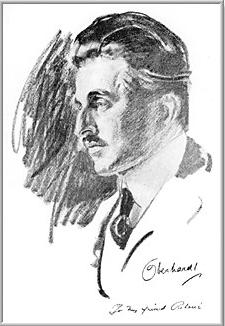
Ameen Rihani (1876 - 1940)
|
|
|
| |
|
|
|
|
| |
|
|
|
|
| |
|
|
|
|
|
|
|
|
|

|
|
|
|
|
|
|
|
|
|